

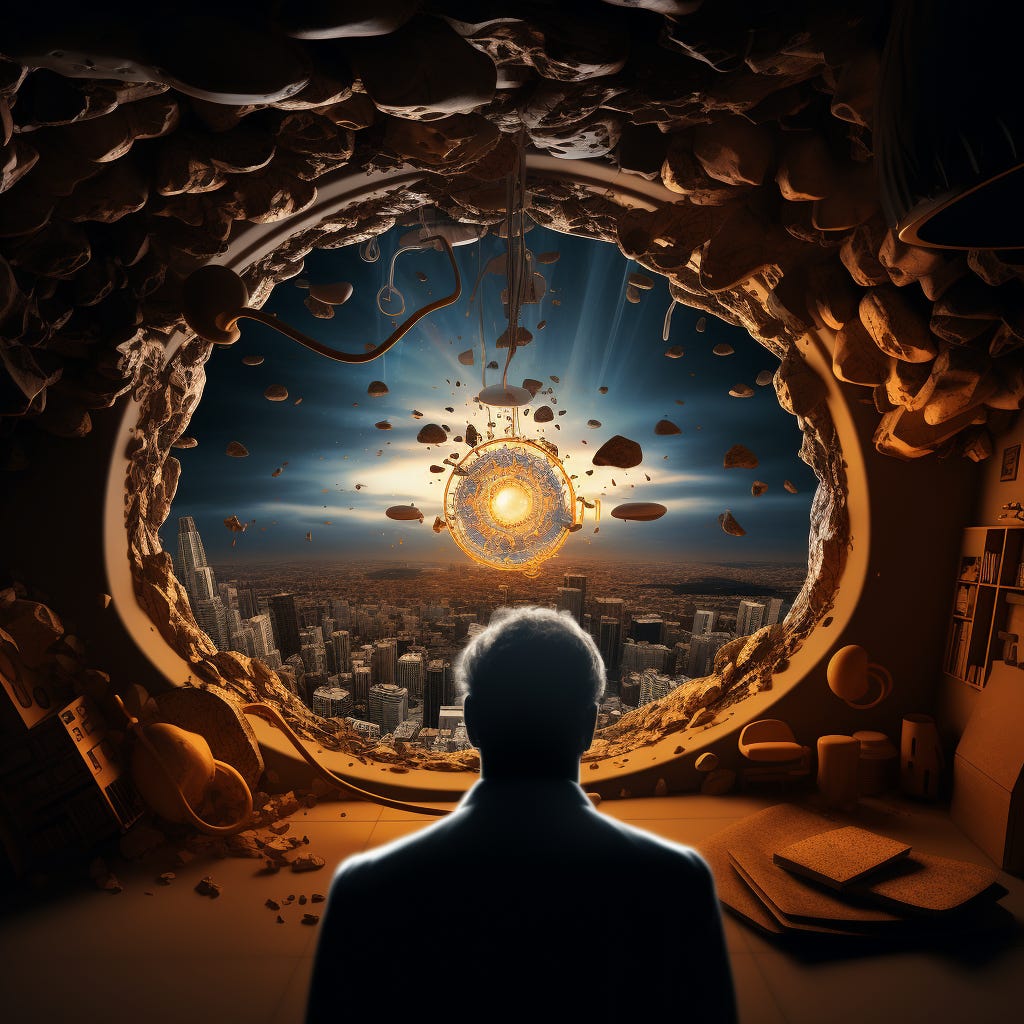
Just recently, I dug up my old notebook from the early years of this century, long before the “AI boom.” In its pages, I found ramblings about how artificial intelligence could shape humanity’s future by putting her at work to solve our most burning issues. Let me share a brief excerpt from it:
16. červen, 2003
…V říši, kde příroda vládne svrchovaně, se na tapisérii existence odvíjí závod o pochopení samotné podstaty života. Je to běh na trati, kde se možná nevyplácí přírodu porazit, protože by se mohla bránit. I tak se ale lidstvo žene za účelem sestrojení inteligence tak výkonné, že už její vývoj samotný zodpoví mnoho otázek dosud nezodpovězených a její výstupy zodpoví mnoho zbývajících. S tím přijde, jako už mnohokrát předtím, posun k hlubší úrovni poznání, která přinese nový pohled na realitu a nové třídy problémů a paradigmat, o kterých se nám ani nesnilo. Pokud se však podíváme na realitu zrakem stroje, nemine nás surový pohled do zrcadla naší vlastní existence obklopený úžasem, znechucením i strachem…
This would translate to English as:
June 16th, 2003
In a realm where nature reigns supreme, a race unfolds upon the tapestry of existence. It’s a race on a track where it may not be wise to defeat nature, for it could fight back. Even so, humanity strives to create an intelligence so powerful that its very development will answer many unanswered questions, and its outputs will provide solutions to the many of remaining ones. With this will come, as has happened countless times before, a leap to the deeper level of reality and a revelation of a new class of problems and paradigms we have never even dreamed of. Yet, when we peer into the fabric of reality through the lens of a machine, we find ourselves gazing into a raw reflection of our existence surrounded with amazement, disgust, and fear.
Back then, the idea sounded outlandish, a dream too far from reality. It’s 2025 now, and the world is awash with AI-driven headlines. It’s the perfect moment to revisit my scribbles and see how they hold up in the present day.
In this series, “23 Questions for AI”, I want to examine the idea of using AI to tackle the world’s biggest problems. But first, before any problem can be put on the table, we need to begin with a few fundamental questions:
How can we formalize and describe the problems, or if you prefer, how should we ask AI models the right questions?
How should we decode and validate the answers without harming ourselves? How can we determine if they are correct or not?
What does it mean to be “correct,” “right,” or “true”? More importantly, is “truth” really the criterion we should use to validate the value of AI’s outputs?
What role does language play in all this? Will we require a new generation of priests to interpret the AI outputs?
What is the importance of data? Is it the whole, clear, and raw reflection of the world around us? How do we find models with the best fit on the data we have?
Join me on this journey to learn how language models resemble our consciousness more than we realize and why understanding the language vehicle and the concept of truth are crucial components of this equation.
Twenty-Three

You are probably wondering—why 23 and not 42?
In 1900, mathematician David Hilbert stood before the International Congress of Mathematicians in Paris to present 23 problems that he believed were crucial to the development of mathematics in the coming century. Although some of those problems remain unsolved to this day, the ripple effect of Hilbert’s challenge reshaped mathematics in profound ways and spurred advances across number theory, logic, and beyond.
Every era has its own grand tasks. For mathematics at the dawn of the 20th century, it was Hilbert’s 23 Problems1—a blueprint for generations of thinkers who sought to push the boundaries of the known. Today, AI has reached a turning point that feels reminiscent of Hilbert’s era, and the problems to be solved call for an equally bold blueprint.
These are the ambitious questions that, once tackled, will shift our understanding of intelligence, consciousness, society, and the underlying fabric of reality itself. They are the questions that, in solving, propel us into an uncharted realm of possibilities.
The 23 is not meant to be a definitive or final number. Rather, it serves as a framework:
To focus collective effort on the hardest, most impactful challenges.
To illuminate unexplored paths where AI might catalyze entirely new paradigms of thought.
To celebrate a tradition of curiosity and intellectual ambition that stretches back into our history.
We know that new puzzles inevitably emerge as soon as one breakthrough occurs.
The hallmark of progress: Solving one problem reveals an entire horizon of others.
Problem Criteria
Not every interesting puzzle rises to the level of a problem. I propose four main basic criteria so we don’t propose bullshit:
Universality: The question addresses a fundamental aspect of intelligence, knowledge, or reality rather than a niche application.
Transformative Impact: A solution (or substantial progress) on this question would dramatically shift how we live, think, and frame other scientific and societal questions.
Testability: Even if the problem is partly philosophical, there should be a theoretical or empirical path to test or validate its solution, progress, or initial hypothesis.
Ethics: We should establish boundaries that reflect ethical values and respect for life, particularly for testing hypotheses.
I considered explicitness one of the criteria, but I’ve decided to put it aside for now. Forcing the question into a strictly formal structure could be counterproductive and limit the set of possible solutions. Let’s revisit it later.
Your Voice Matters!
Throughout this series, you’re invited to:
Propose new challenges, questions, and problems you believe could meet the criteria. Or challenge the criteria themselves!
Debate the feasibility or importance of the problems discussed.
Contribute to refining the final 23-problem list or the criteria. Perhaps your insights will highlight an angle no one else has considered.
Challenge!
Ultimately, this series aspires to crowdsource a grand vision that ties together the genius and curiosity of thousands of minds, just as Hilbert’s Problems rallied the mathematicians of the 20th century. Each problem we propose paves the way for new discoveries, fresh paradigms, and deeper insight into the nature of intelligence, ourselves, and our reality.
Perhaps even some of the unsolved Hilbert’s problems will appear in the list we will build together…
Hilbert’s Problems: List of the most critical mathematical problems in early 20th-century.