
Entropy’s Two Faces
How black holes and quantum noise mirror each other as boundaries of information.

As creatures of intellect, we constantly push the frontier of knowledge. Some fear that if we push too far, we may disturb the universe from its natural order. Luckily for them, all our knowledge is just a blurry snapshot of what we can perceive within the short span of our lifetime, limited by how far we can reach.
The furthest scales we have explored — with JWST scanning galaxies, TEMs peering into matter, neuroscience mapping the brain, or submersibles descending into the Mariana Trench — remain many orders of magnitude away from the very fabric of reality.
When we look in both directions — out into the cosmic vastness or inward into the quantum depths — we reach barriers that seem to connect the very large and the very small.
Are they two sides of a single coin?
I’ve been contemplating this idea for nearly two decades and have finally decided to share some of my notes. Quantum gravity has always been one of those paradoxes that kept me awake at night or occupied my thoughts whenever I was on the train home, gazing out the window and letting my mind drift. Those were times long before everyone had phones to stare into.
The Macro Horizon: Black Holes
Mass “stores” information via its gravitational field, and when too densely allocated into too small a region, we see it collapse into a black hole.1 Black holes define an event horizon: a threshold beyond which nothing, not even light, can escape, and the information is scrambled in ways we don’t yet understand. From the viewpoint of causality, the horizon is not a material surface but an informational one.
The information paradox of black holes is well known: does information disappear entirely, or is it somehow preserved on the horizon itself, encoded in the faint Hawking radiation?2 The holographic principle suggests the latter — that the universe may be written on surfaces rather than volumes.3 Either way, the event horizon is an informational prison: once crossed, details of the past dissolve into an indistinguishable thermal haze, at least until we solve quantum gravity.
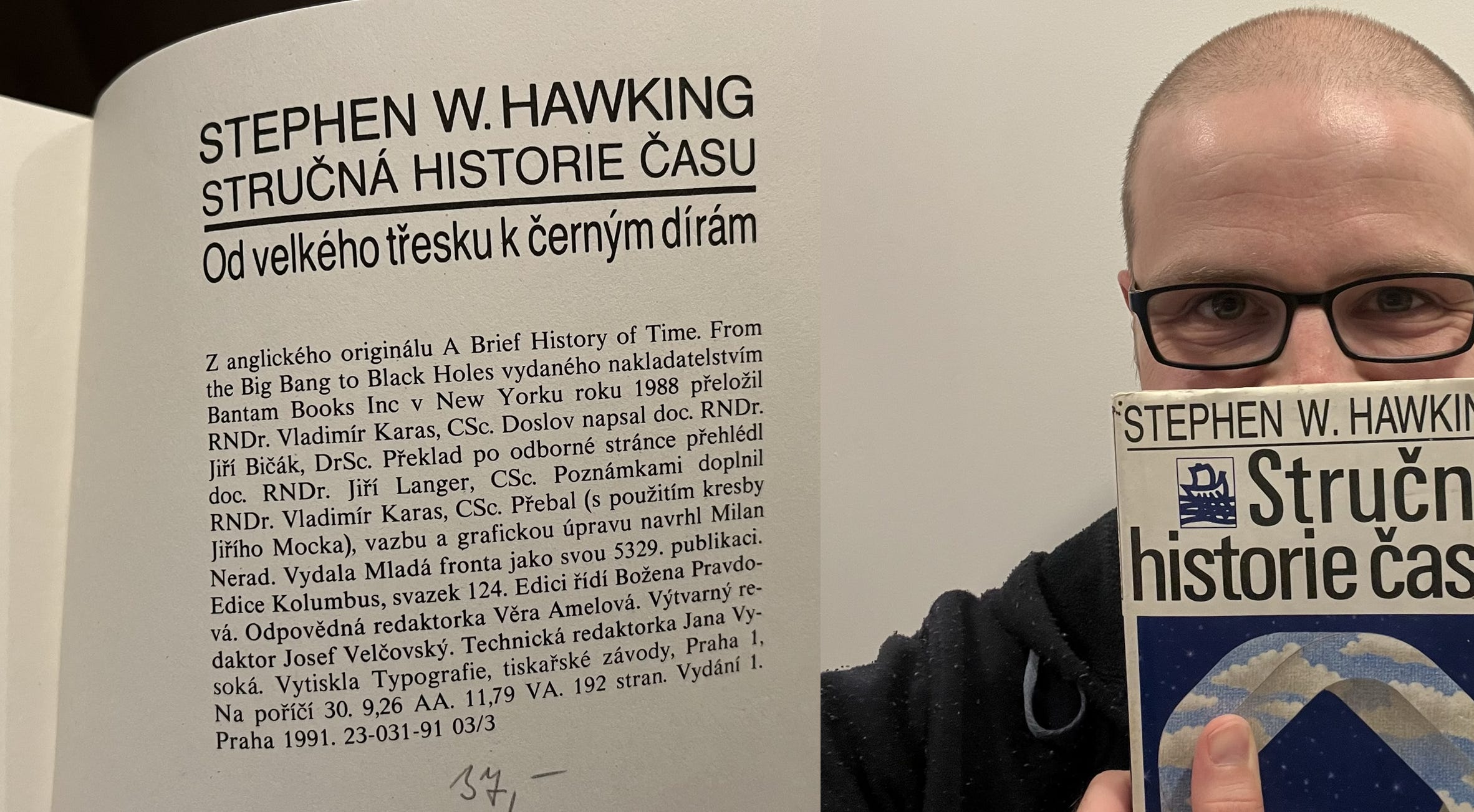
My first encounter with Stephen Hawking’s “A Brief History of Time” was in 2002. I was at the observatory in my hometown of Jeseník, a place where I spent many wonderful years, first as a student and later as a teacher. This book, which was part of the observatory’s collection, ignited my understanding of the cosmos, helping me internalize concepts like distance, size, mass, and gravity. I’ve since moved on, but the book never did — I must admit, I never returned it.
How Far Can We Go?
The heaviest known black hole is likely Phoenix A (at the center of the Phoenix galaxy cluster), with an estimated mass of about 100 billion suns.
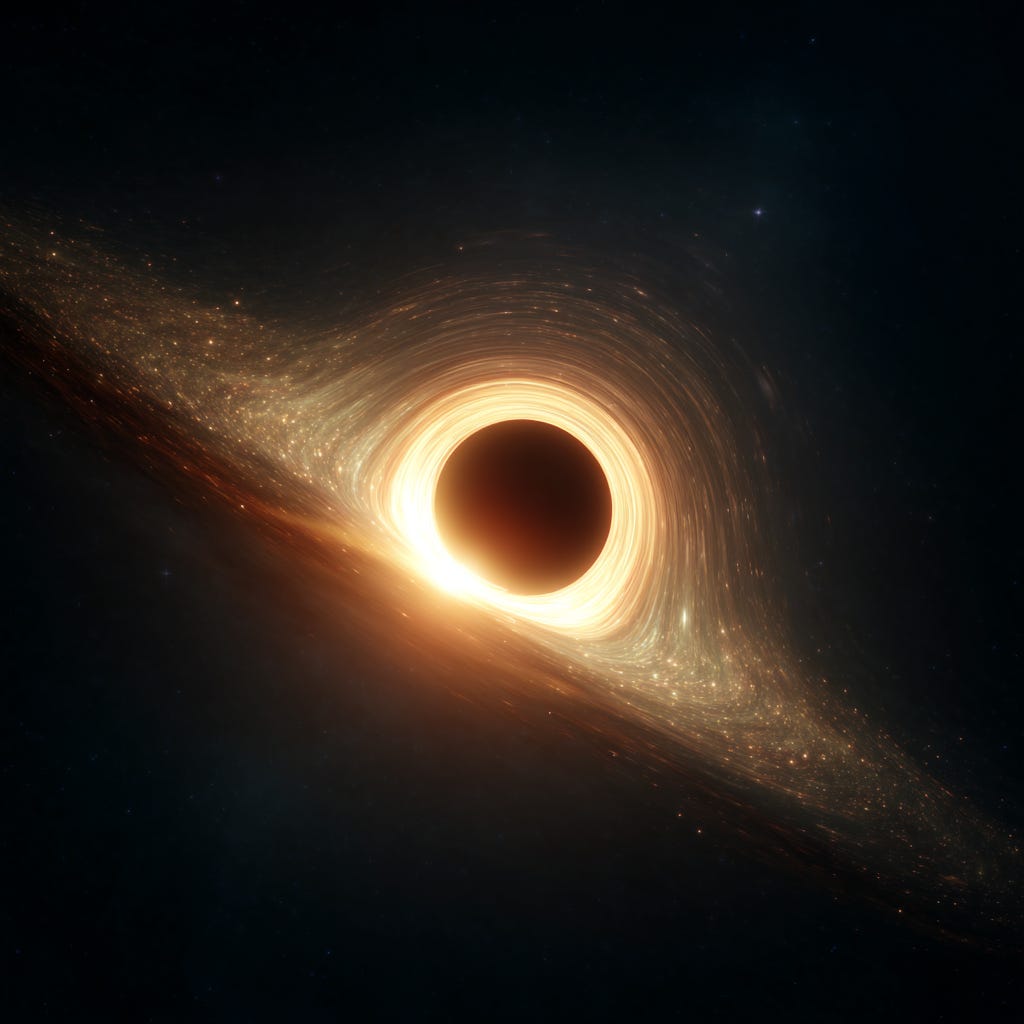
It’s located 5.8 billion light-years away and captures an estimated 1.5×10⁹⁹ bits of information. With a Schwarzschild radius of approximately 2.95×10¹⁴ meters, it’s a behemoth 42,000 times larger than our Sun’s radius. Its gravitational pull is so immense that we’re lucky to be so far away from it.
Its event horizon is likely the biggest information horizon in the observable universe.
The Micro Horizon: Quantum Limits
If a black hole’s event horizon is the limit of retrieval, its mirror lies at the other extreme: the limit of resolution where information can’t be distinct from randomness. We model these horizons as holograms, surfaces, strings, foam… Abstractions not far from the two-dimensional event horizon of a black hole.
Heisenberg’s uncertainty principle makes precision in one property erase precision in another. At small enough scales, the act of measurement disturbs the system until outcomes blur into noise.
A signal that approaches pure noise carries no structure. In terms of Kolmogorov complexity, the shortest description is the signal itself — incompressible, indistinguishable from chance.
Both these principles point to a similar conclusion.
How Deep Can We Go?
This “microhorizon” takes several forms: the Planck scale, where spacetime itself may break down; Landauer’s principle, which ties information erasure to minimal energy costs; and quantum decoherence, where superpositions leak into the environment until they can no longer be distinguished. All point to a horizon of measurability, beyond which structure collapses into fog.
At distances smaller than the Planck length
where quantum gravity effects are expected, attempts to probe more precisely would concentrate enough energy to create a singularity (micro black hole), hiding the information again.
The Supersymmetry
Both horizons are limits of distinguishability.
At the macro scale, black holes scramble information until it cannot be recovered.
At the micro scale, quantum noise drowns states until they cannot be told apart.
In both directions, entropy saturates, and the effect is the same: information becomes inaccessible.
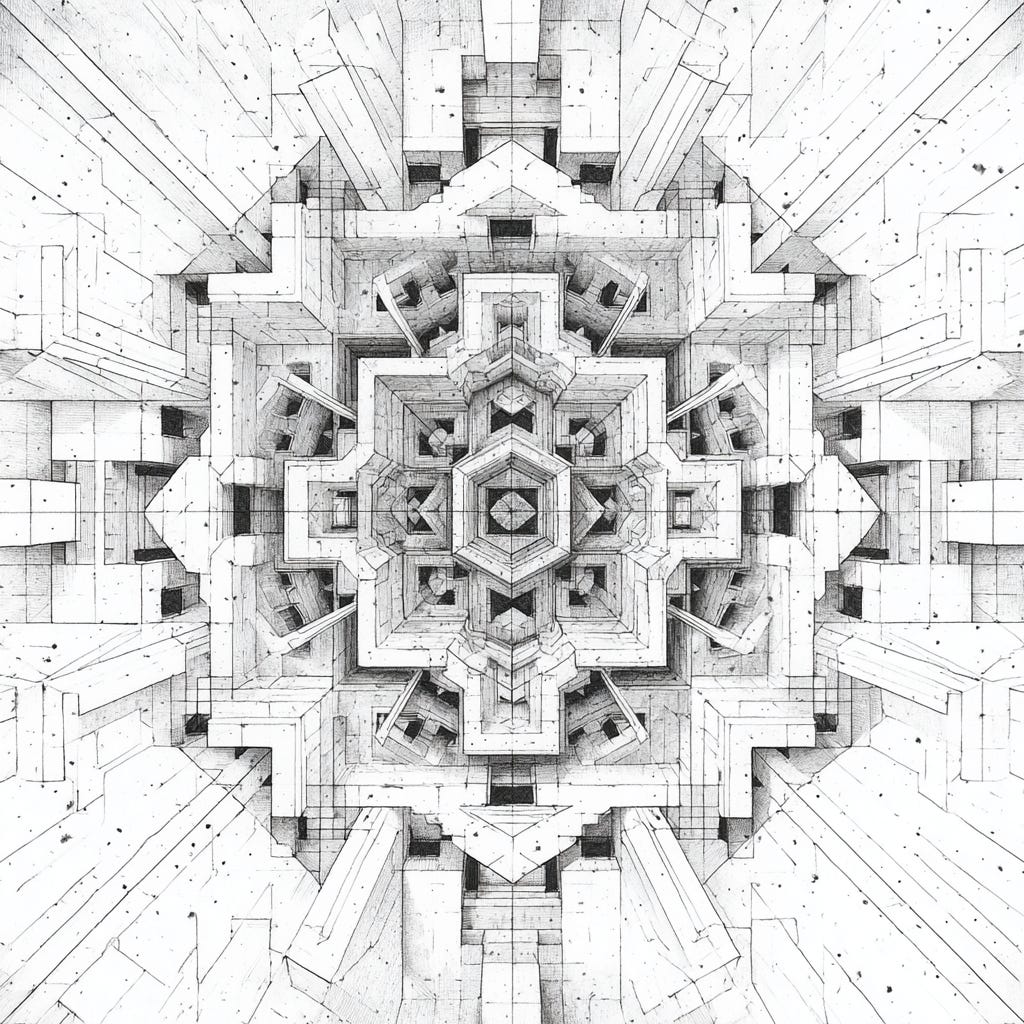
Both may be expressions of the same holographic encoding at different scales. At the micro scale, trying to measure below the threshold creates a horizon. At the macro scale, piling on mass beyond a certain density creates a horizon.
If these horizons are not separate, then perhaps the universe is a single informational manifold. Large and small aren’t opposites, but projections of the same boundary from different perspectives.
Both are telling us the same: attempts to extract information beyond a critical threshold generate an event horizon.
Implications
Distinguishability can be formally captured by relative entropy4, which measures how one probability distribution differs from another. At both the black hole and Planck scale “horizons,” this value approaches zero, which we can write as:
This lack of distinguishability appears to follow a surprising scaling symmetry at both ends of the cosmic spectrum:
At the macro scale (black holes), the Bekenstein-Hawking entropy (SBH) scales with the square of the mass, which in turn is proportional to the surface area of the black hole’s event horizon. This remarkable relationship suggests that the information content of a black hole isn’t proportional to its volume, but to the area of its surface, expressed as:
\(S_{BH} ∝ M^2\)At the micro scale (Planck regime), the entropy density (s) scales with the inverse square of the Planck length (lₚ). Because the Planck length represents the smallest possible scale at which spacetime can be measured, this formula implies that the information density at this fundamental level is also a function of a surface-like boundary:
\(s ∝ 1/\ell_p^2\)
Both follow a quadratic law in surface terms — hinting at a unifying geometry of information, suggesting that the same underlying principles may govern the behavior of information at both the largest and smallest scales of the universe.5
Between Horizons
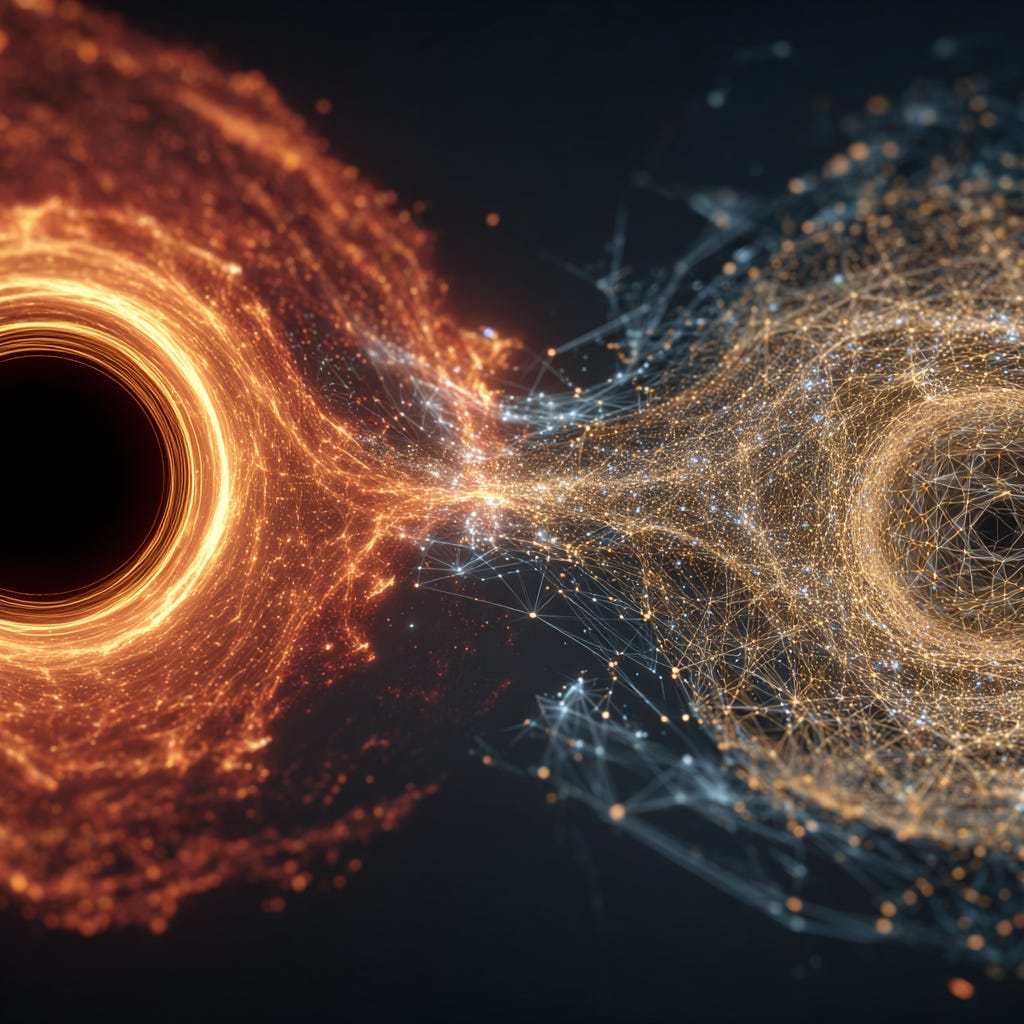
If these horizons are two faces of a single dualistic boundary, then the real question is not what lies beyond them, but what it means to live between them. We are creatures suspended between these information veils, decoding what structure we can before it dissolves into fog or vanishes into the dark. Our task is not to escape these barriers, but to map the territory they enclose—to learn what order exists inside the finite, and to understand how meaning survives between the extremes of noise and oblivion.
This sharpens the debate about determinism. If randomness is truly fundamental, then entropy is unbounded and the universe indeterminate. If randomness is only apparent—the scrambling of information behind horizons—then chance is ignorance, not destiny.
The same logic underpins the question of whether we live in a simulation. Is the information we see emergent and self-contained, or encoded by deeper rules we cannot yet touch?
Either way, the universe is an information system with limits.
Full entropy except for black holes is not observed to be locally achievable. If black holes do not randomize (entropize) the information totally and some information can leak back, then it’s not achievable at all.6
Life Between the Veils
Life is a prime example of a system that locally and temporarily fights against this natural increase in entropy.

Every act of living is a form of information processing. A thought, a decision, or a moment of contemplation is a bifurcation of possibility. It’s what transforms the potential into a specific action, making life forms agents of change. Each action is the integral of initial and final states, a physical manifestation of a choice.
Perhaps life emerges when entropy is at its lowest point in a local system, as the universe seeks to express its full potential. However, it’s a property that can only flourish under specific conditions, and it does not always have the ideal environment to maintain high complexity.
The cosmic stage between the horizons of disorder is, in essence, where life plays out.
Thank you for reading! I will be exploring life and its connection to information as part of this series. If you want to be part of it or just learn more about information, entropy, or gravity, subscribe!
If you’re interested in exploring some visualizations I created to complement this article, visit my GitHub and try out the demo.
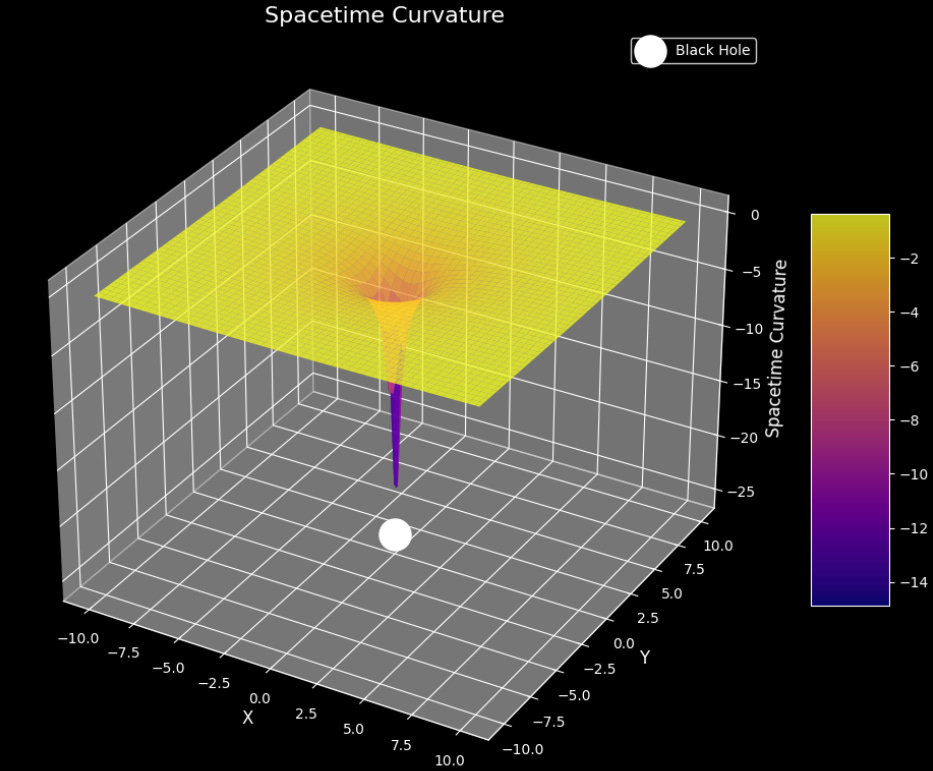
In gravitation and black hole thermodynamics, mass contributes to the horizon area. Via the Bekenstein–Hawking relation, that area encodes maximal information: in that sense, mass can be seen as information densely allocated.
Leonard Susskind, “The World as a Hologram,” Journal of Mathematical Physics, 1995. https://www.sciencedirect.com/topics/physics-and-astronomy/holographic-principle
In one of the following articles, I would like to expand the idea of Diversity–Compression Entropy, a measure that shifts the question from “how much disorder exists?” to “how much of the world’s possibility space are we willing to collapse in order to learn?”
In practice, local systems do not reach maximal entropy; black holes approximate maximal entropy for given mass and charge, but whether absolute entropy ever obtains (even inside) is unknown.