


This release is dedicated to the Riemann zeta function and accompanies my “Meridian of Primes” series on the Riemann Hypothesis.

Back in 2004, while I was still in high school, I attended a guest lecture on RSA by a visiting mathematics professor from Palacký University in Olomouc. I don’t remember his name, but the lecture was so good that it pulled me deeper into prime numbers, cryptography, and the strange question of how mathematics can describe the distribution of primes.
What fascinated me at that point was that even after so many years, we still do not fully understand the pattern behind them (Riemann postulated the hypothesis in 1859). I filled a few journal pages with notes on the topic back then, and apparently never quite let it go.

At the same time, I was learning about complex numbers in school. They felt bizarre at first. Strange, abstract, almost artificial. And then I discovered that these weird imaginary constructions are deeply connected to the very real, very classical world of prime numbers.
So I decided to connect the topic of primes and complex numbers and start a new series on the Riemann Hypothesis. Not because I plan to solve it, but because I want to explore what it is, why it matters, and how the thinking around it works.
And because Synaptory Fractal Traveler had already grown beyond fractals, this update finally pushed me to rename it. It’s now called Synaptory Chaos Explorer, but the name changes... chaotically :)
The Riemann Zeta Mode
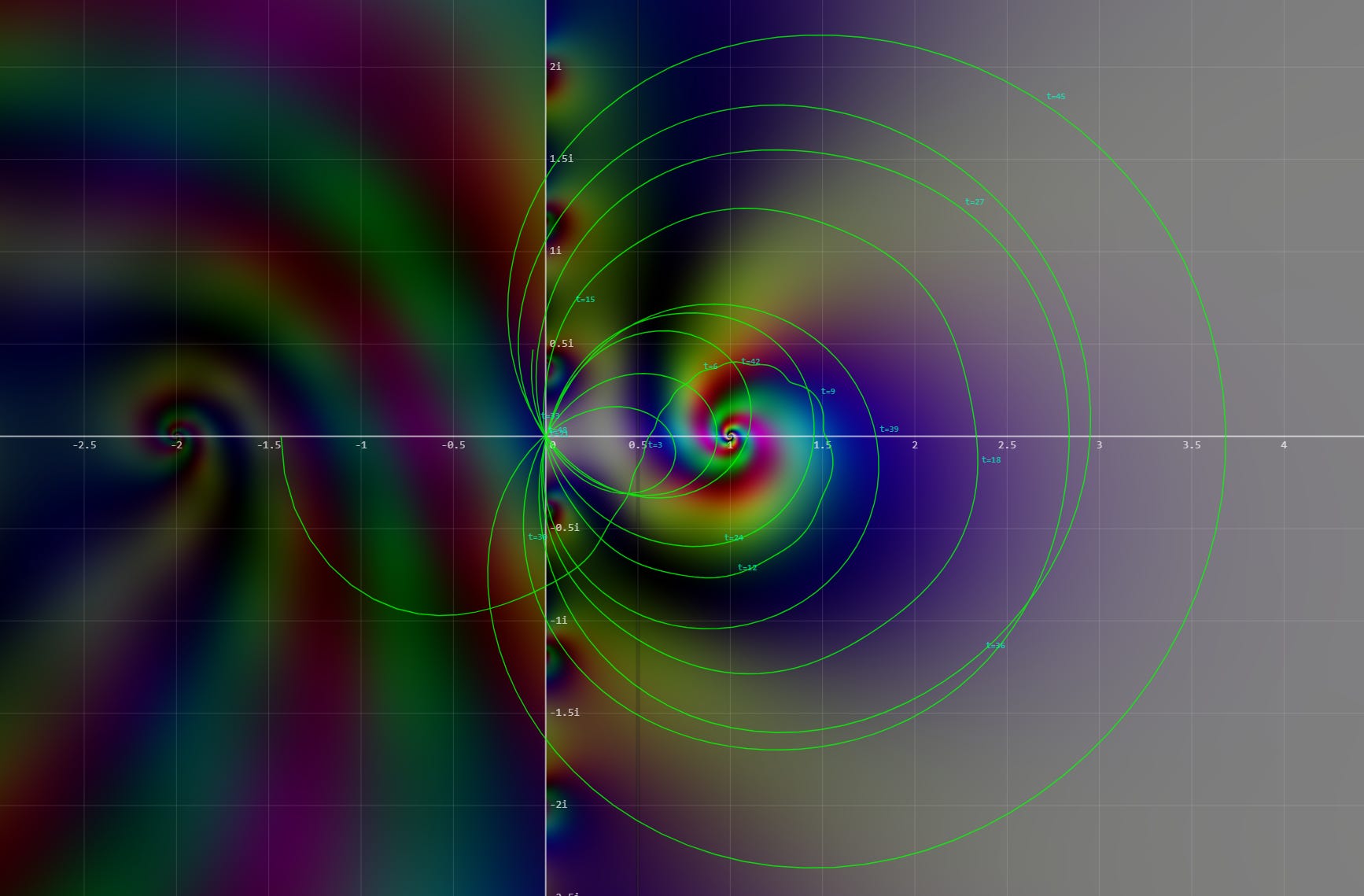
With version 2.2, Synaptory Chaos Explorer now includes a new mode for exploring the Riemann zeta function (ζ). You can now explore:
A critical line overlay at Re(s) = 1/2
The zeta path — the famous visual trajectory of ζ(1/2 + it)
An analytic continuation for exploring zeta on the full complex plane
And most importantly, the release includes a guided audio-visual tour through 29 curated mathematical points of interest, including:
Trivial zeros at the negative even integers
Non-trivial zeros on the critical line, including Gateway Zero, Hardy’s Milestone, or Lehmer’s Phenomenon
Special values such as the pole, the Basel problem, Apéry’s constant, or Ramanujan summation1.
Historical landmarks, including Titchmarsh’s last zero or Turing’s last zero
Yes, 29 is a prime number.
What Else Is New in 2.2
Although this release belongs primarily to the Riemann zeta function, it also pushes the explorer further beyond its original fractal boundaries.
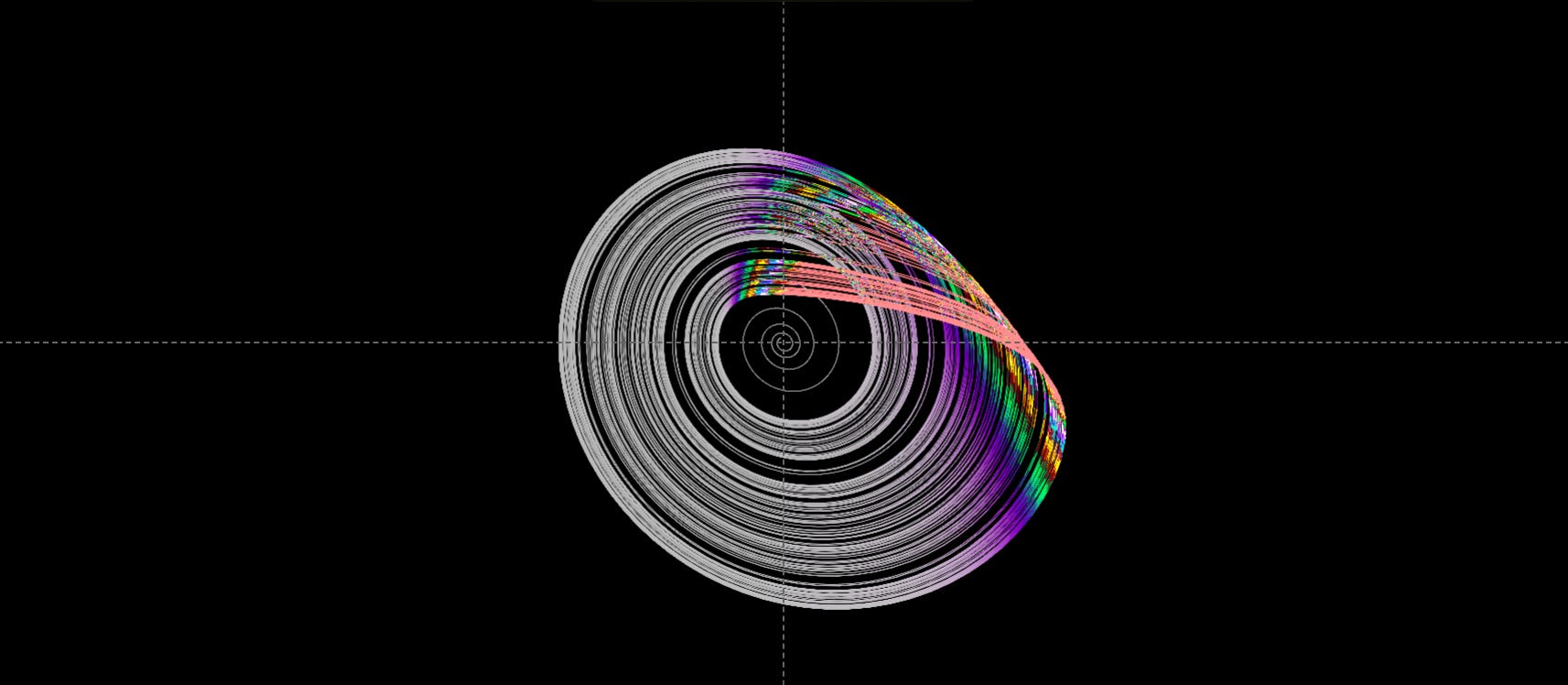
I have added a beta implementation of the Rössler attractor as an early preview of one of my future essays on chaos. It is still unoptimized and experimental, but already stable enough to explore if your machine can keep up.
I have also upgraded the Mandelbrot engine with a new series approximation shader, which improves deep-zoom rendering by making extreme magnifications faster, cleaner, and numerically more stable.
Beyond that, version 2.2 adds a new Chaos Gallery for curated captures, smoother tours, richer overlays, expanded keyboard controls, better mobile interaction, internal rendering and architecture improvements, and a substantial set of bug fixes.
So while the zeta function is the headline, this release also marks a broader transition: the project is becoming less a single-purpose fractal viewer and more a growing laboratory for visual mathematics, chaos, and complex systems.
You can find full release notes here.
Give It a Try
Live app: fractal.brnka.com/#zeta
Source code & Wiki: github.com/rbrnka/fractal-traveler
Enjoy!
As usual, subscribers are the first to learn about the new version before I announce it more broadly on social media.
Stay tuned for the upcoming “Meridian of Primes” essay to learn more about these special values of ζ(s)