


On the strange atlas of the complex plane, where numbers become geometry and geometry becomes chaos, a unique meridian appears. It marks a boundary between what mathematics has proved and what it has only tested to extraordinary depth.
This essay is a guided walk toward that meridian. Just enough mathematics to see its outline, just enough philosophy to appreciate why it feels so uncanny, and just enough restraint not to pretend we have solved the mystery.
The line is simple, but the claim attached to it remains unproven.
It appears in the Riemann Hypothesis, one of the most famous unsolved problems in mathematics1. The claim is simple to state and extraordinarily hard to prove: all non-trivial zeros of the analytically continued Riemann zeta function lie on that line.
Behind that sentence sits a deeper conceptual shift. To even understand what the claim means, we have to leave behind the naive idea that a formula is only what its original series says it is. We have to talk about convergence, divergence, and one of the strangest moves in mathematics: analytic continuation.
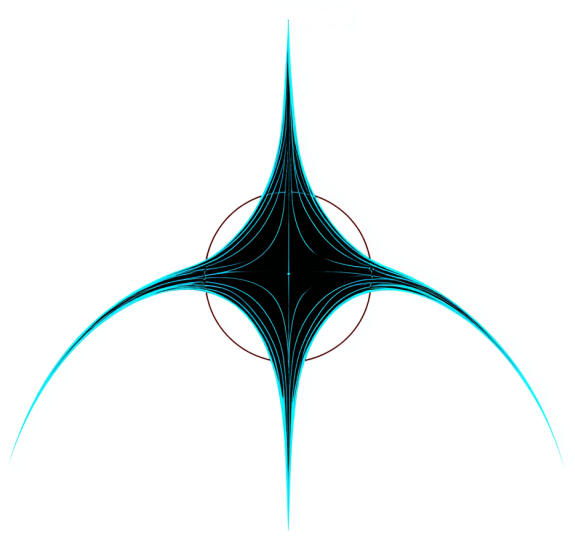
If mathematics has something like an “event horizon,” this problem is one of its best candidates. Yet its proof remains elusive. Proving or disproving it would reshape parts of number theory and would echo far beyond it, including areas tied to prime distribution, computation, and mathematical physics.
You’ll need curiosity more than credentials. Some algebra helps. Comfort with the idea that math can be strange and still be rigorous helps more.
The Complex Plane
Most people have heard of complex numbers. But what are they really?
We make a mathematically radical move. We say that there is a solution to this simple equation
by introducing a symbol that is not a real number, but whose square is −1. We call it i, define it as
and ask what algebra it forces into existence. The answer is the system of complex numbers, an algebraically closed field, richer than anything that had come before, extending real numbers this way:
Taming Infinity
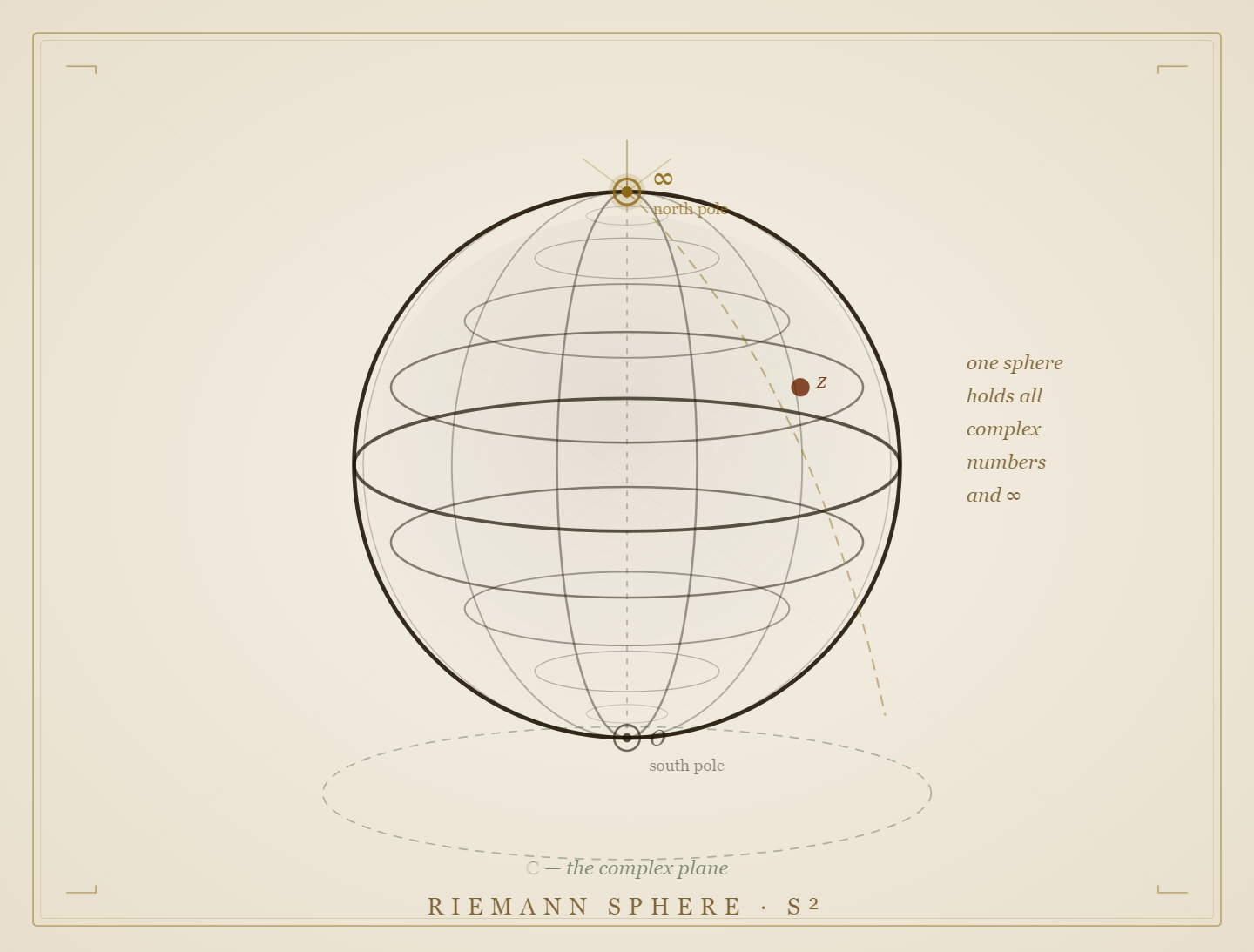
The most beautiful atlas in the history of mathematics to visualize the extended complex plane2
is the Riemann sphere.
Imagine it as a sphere resting on the origin of the infinite complex plane, at the point zero. We connect every point in the plane to the sphere’s North Pole with a straight line. Where that line pierces the sphere’s surface, the image of the number is born.
Points near zero cluster at the South Pole. But the further you venture into the plane, the higher you climb upon the sphere. All paths to infinity, regardless of their direction, eventually converge at a single point: the North Pole.
This way, Riemann transformed an infinite, ungraspable expanse into a compact, closed object3. Infinity is no longer an abstract abyss; it is a concrete point on a map. And it is within this enclosed world, where algebra meets geometry, that the zeta function begins to reveal its deeper meaning.
Rituals of the Infinite Sum
Before we touch the zeta function, we need to talk about a kind of social contract mathematicians make with infinite series.
An infinite series is a promise that says: “If you keep adding, forever, you approach something.” Sometimes this is true in a way that feels natural. If the terms shrink fast enough, the sum settles down to a number. We say it converges. Sometimes it’s false in the weirdest way possible because the sum simply refuses to be a number, and the series diverges—explodes to infinity or keeps oscillating.
Let me begin with one of the simplest examples:
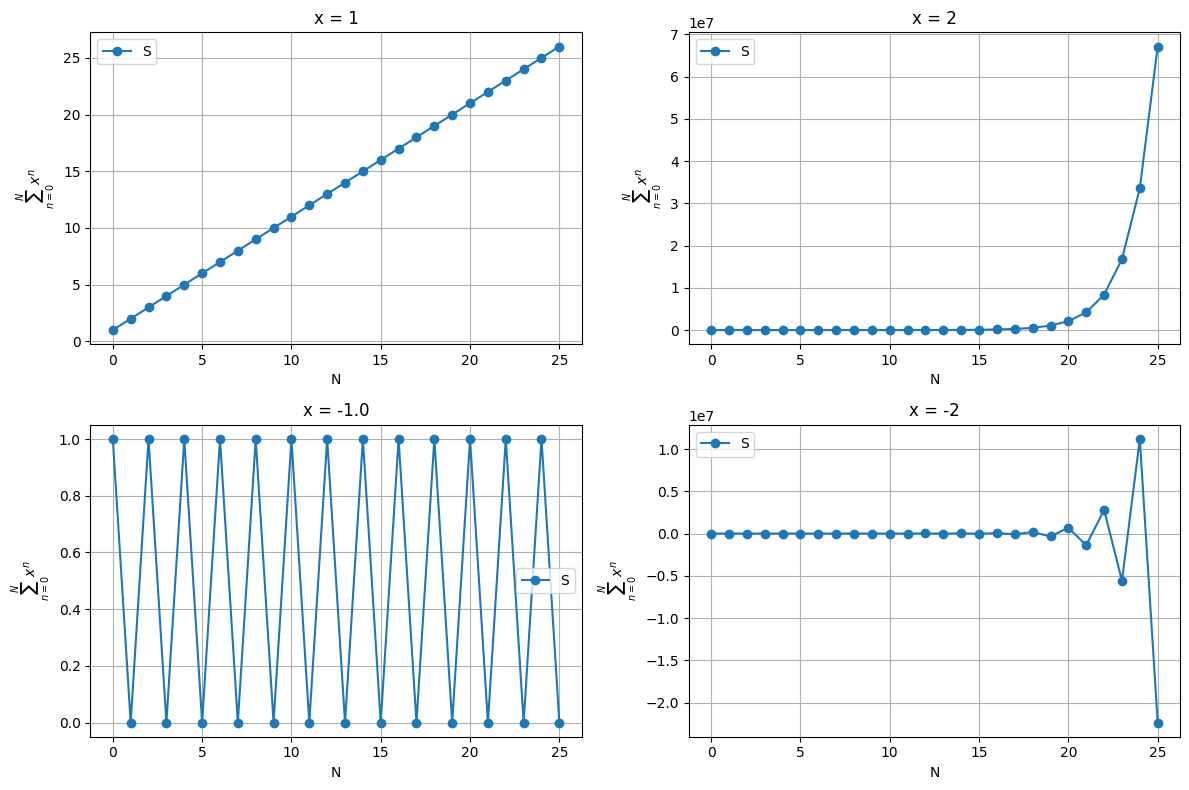
This is a geometric series S, and it only converges in the narrow interval between -1 and 1 described as:
At x=−1, the partial sums oscillate between 1 and 0. At x=1 they grow without bound. Have a look:
SHow to find its sum within the convergent interval? Instead of trying to add infinitely many terms one by one, we can manipulate it algebraically. Let’s multiply both sides by x:
and subtract from the original sum:
Everything cancels except the leading 1. Now, to get the sum to one side of the equation and the rest to the other:
Summoning the Right Spirit
We have found a closed-form expression for the sum, but only on the interval where the original series converges. The formula itself, however, defines a function on a much larger domain. Outside the convergence interval, that function still has values, but those values are not the sums of the original series:
How is this possible?
We don’t always treat divergence as failure. Sometimes we treat it as a coordinate change: a hint that we’re summoning the right spirit with the wrong ritual.
Let’s dive in and express the new formula as a function of a real variable x:
We intuitively feel that the function g(x) is somehow extending the S because while equivalent, it works on a broader domain. Let’s plot them both:
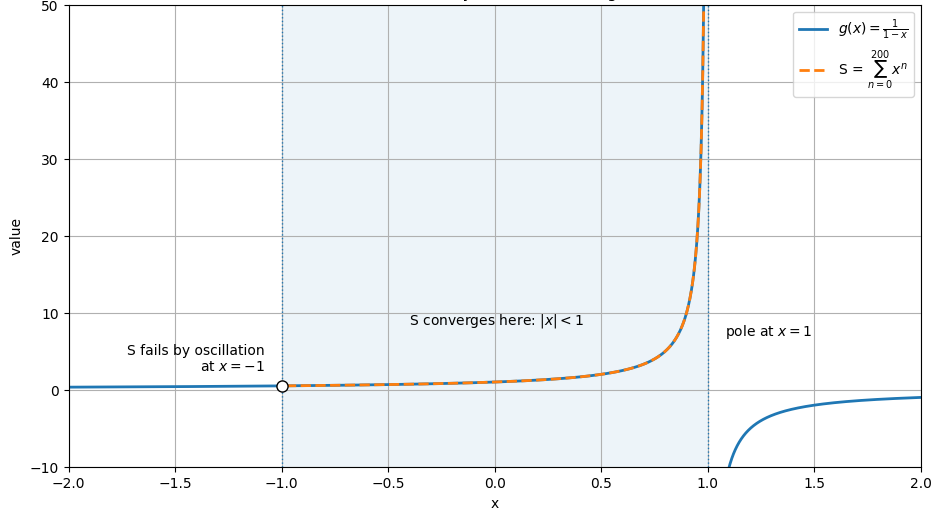
S and its analytic continuation g(x)We can see that g(x) agrees with the series on the interval where the series converges, but remains defined on a wider domain4.
This is the basic idea behind analytic continuation: the series defines a function on one region, and that function can sometimes be extended beyond it.
Over the real numbers, many different functions can agree on the same interval and then diverge elsewhere. In the complex plane, analytic functions are much more rigid: if an analytic continuation exists on a connected domain, it is unique.
Beyond Convergence
Let’s play with the g(x). For x=1/2, we get the same result as S. As expected, both give the same value inside the interval of convergence:
Let’s try some of the values outside of the S domain.
As we already know from the graph above, S diverges at +1 while g(x) has a pole there5. How about -1?
For x=−1, the series becomes 1−1+1−1+… Its partial sums oscillate between 1 and 0, so the series does not converge in the usual sense. The function g(−1), on the other hand, gives 1/2, which can be viewed as a generalized value associated with that oscillation6.
Here’s where things get uncomfortable. Let’s try a number 2.
At x=2, the S diverges. The continuation doesn’t. They’re built from the same definition, yet one refuses to answer and the other hands you a number.
This is where the distinction stops feeling like a technicality and starts feeling philosophically strange. The continuation isn’t lying. It’s speaking a different dialect of the same truth. Whether those dialects are equally “real” is a question mathematicians and philosophers still argue about over coffee.
Let’s plot them both:
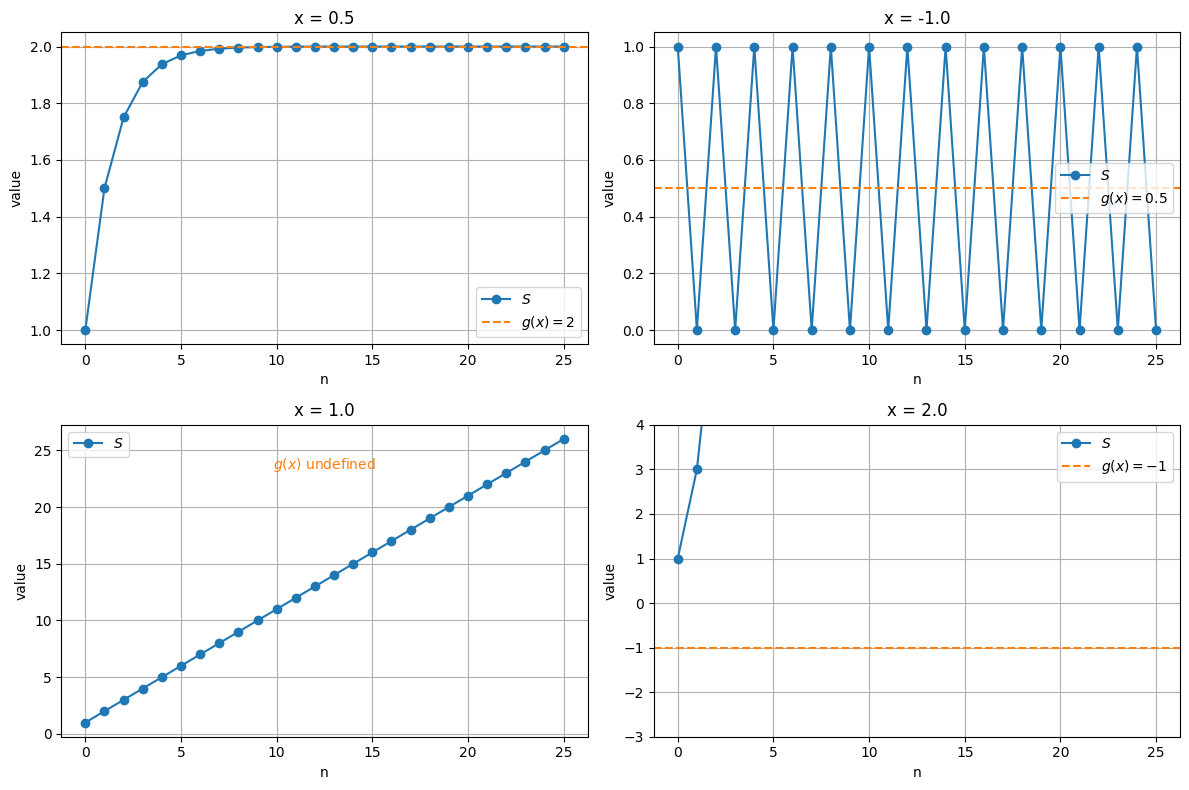
S(x) and g(x)We can see a very different behavior outside the domain of S. Where S does not converge to a sum, its analytic continuation yields a result (except at +1). The distinction between a function and the series that defines it locally is one of the conceptual keys to the Riemann hypothesis.
But what is the semantics of the number we’re getting? It’s surely not a series sum!
What we get is the value of a different object: a function that agrees with the series where the series converges, and continues beyond that region.
Same voice, wider range.
This is the threshold Euler stepped across in the 18th century, when he faced a problem that had resisted solution for nearly a century: the exact sum of the reciprocals of all perfect squares, known as the Basel problem.
If Euler found the heartbeat of these series, Riemann found their DNA.
In the next part, we will see how the Basel problem evolves into the Zeta function, a mathematical prism that refracts the chaotic sequence of primes into our meridian.
Thanks for reading!
Riemann hypothesis is also likely the most difficult way to earn a million dollars: Millennium Prize Problems
“Extended complex plane” means the complex plane plus one point at infinity.
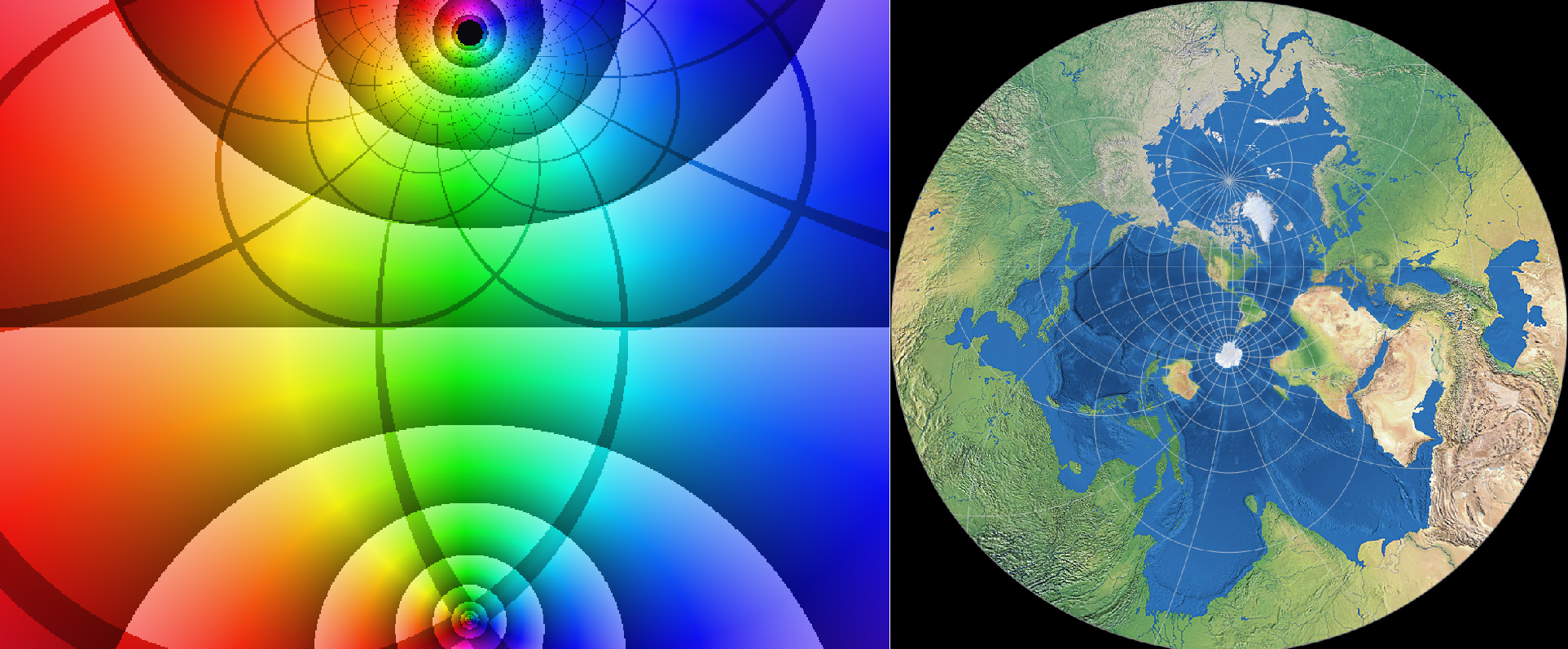
It’s called a stereographic projection: a way of mapping the surface of a sphere onto a plane while preserving angles and circles.
The partial sums approach the function more closely as n increases. In the plot, I used 200 terms, which is enough to show the behavior clearly inside the convergence interval.
A pole is a type of isolated singularity, in this case, an infinity.
Also called the Abel sum of the series.